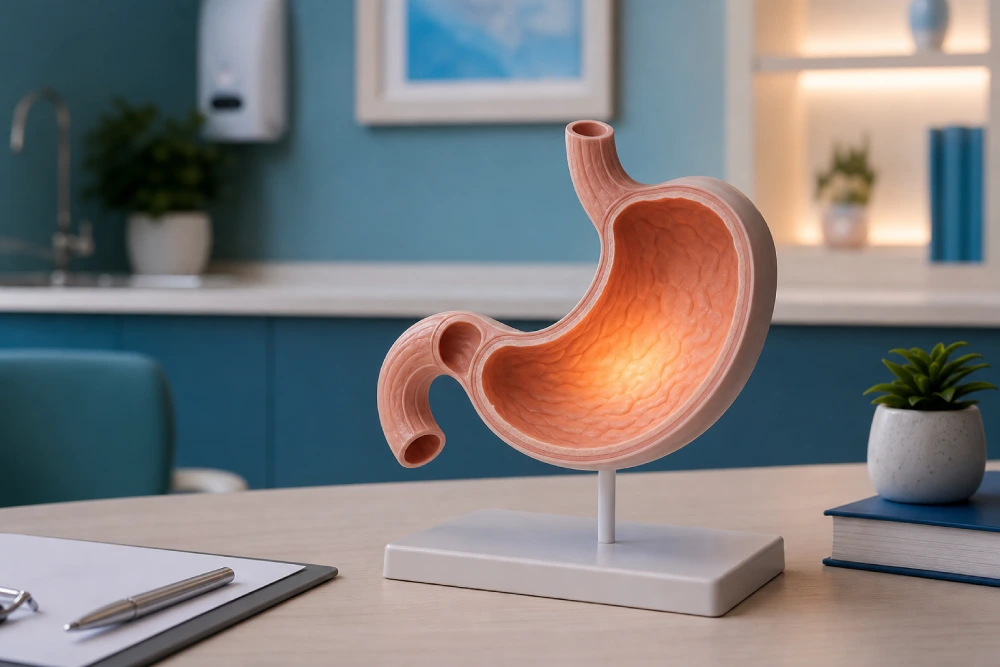
Dyspepsia is the medical word for indigestion: pain, burning or an uncomfortable fullness in the upper tummy, usually after eating. Most episodes settle with simple changes. When dyspepsia symptoms keep coming back or arrive with warning signs, Dr Ganesh Sivaji, a Harrogate consultant gastroenterologist, looks for the cause, such as reflux, gastritis, an ulcer, H. pylori or a medicine, and treats that cause.
What Is Dyspepsia (Indigestion)?
Most people have indigestion at some point, and it is rarely a sign of anything serious. NICE describes it broadly as recurring upper-tummy pain, heartburn or acid coming back up, with or without bloating, nausea or vomiting.
People usually see Dr Sivaji when indigestion has returned for weeks or months, or pharmacy remedies only help for a while. He takes a careful history, tests where it is useful and bases the plan on what he finds.
Indigestion Warning Signs That Need Urgent Help
| Symptom | What it may mean | What to do |
|---|---|---|
| Vomiting bright red blood, or vomit that looks like ground coffee | Bleeding in the stomach or gullet | Call 999 or go to A&E |
| Black, sticky and very smelly poo | Bleeding higher up in the gut | Call 999 or go to A&E |
| Severe tummy pain, or chest pain that started suddenly | Possibly a perforated ulcer or a heart problem | Call 999 or go to A&E |
| Losing weight without trying, feeling full after a very small meal, or a lump in your tummy | Needs checking quickly | Urgent GP appointment or NHS 111 |
| Pain or difficulty when swallowing, or being sick again and again | Needs checking quickly | Urgent GP appointment or NHS 111 |
| Indigestion that keeps returning, or iron deficiency anaemia | Needs assessment | See your GP or a gastroenterologist |
These steps follow the NHS guidance on stomach ulcer symptoms. If you need A&E, ask someone to take you or call 999 rather than driving.
Dyspepsia Symptoms and the Conditions Behind Them
Heartburn, bloating, feeling sick, burping and bitter fluid coming back into the mouth are all forms of indigestion. Behind them sits one of a handful of causes:
- Acid reflux and GORD: acid travelling up towards the throat, felt as heartburn or a sour taste; frequent reflux is called gastro-oesophageal reflux disease.
- Gastritis: an irritated, inflamed stomach lining, linked to H. pylori, anti-inflammatory painkillers or alcohol.
- Stomach and duodenal ulcers: sores in the stomach or the start of the small intestine, often a burning pain that is worse at night.
- H. pylori infection: a bacterium in the stomach that is one of the main causes of gastritis and ulcers.
- Medicines: anti-inflammatory painkillers (NSAIDs), steroids, bisphosphonates, nitrates and calcium-channel blockers.
- Hiatus hernia: part of the stomach sliding up into the chest, which makes reflux more likely.
- Indigestion with normal test results: when a gastroscopy and other tests show no cause, the diagnosis is often functional dyspepsia, a real and treatable condition.
- Something more serious: rarely, stomach cancer, which Dr Sivaji diagnoses and refers on to the cancer team.
NICE also asks doctors to consider heart and gallbladder disease. If your discomfort sits lower down, with a change in bowel habit, read about irritable bowel syndrome.
How to Treat Dyspepsia: Treatment Options by Cause
NICE sets out a stepwise approach, and the right step depends on what is behind your symptoms.
Lifestyle Changes
Losing excess weight, stopping smoking and cutting down on coffee, alcohol, chocolate and fatty food can help. Leaving 3 to 4 hours between your last meal and bed can help at night.
Antacids and Alginates
Pharmacy medicines that calm burning for a short time. They do not treat the cause and are not meant for regular long-term use.
Acid-Reducing Medicines
NICE recommends a full-dose proton pump inhibitor (PPI) for 4 weeks, or an H2 receptor antagonist if a PPI does not help. Afterwards the aim is the lowest dose that controls symptoms.
H. pylori Test and Treat
A breath or stool test looks for the bacterium. If it is found, NICE recommends a 7-day course of a PPI with two antibiotics.
Healing an Ulcer
Stopping anti-inflammatory painkillers where possible and 8 weeks of acid-reducing medicine let an ulcer heal, followed by H. pylori treatment if needed and a repeat test 6 to 8 weeks after starting.
Watching and Waiting
With mild symptoms and no warning signs, you may choose to change your habits first and hold off on medicines or tests, coming back if things change.
Why Patients Choose Dr Sivaji for Indigestion That Keeps Coming Back
- The cause comes first: he investigates why indigestion keeps returning instead of trying one medicine after another.
- One doctor from start to finish: the consultant who assesses you can perform your gastroscopy and talk you through the findings straight afterwards.
- Plain explanations: you leave each visit knowing what happens next.
- Follow-up built in: review appointments let him adjust the plan if your symptoms change.
- An NHS consultant too: he works for Harrogate and District NHS Foundation Trust, a consultant post held since 2010.
Recognised expertise:
- MBBS, MRCP (UK) and FRCP, a Fellow of the Royal College of Physicians
- Full membership of the British Society of Gastroenterology; membership of the European Society of Gastrointestinal Endoscopy
- On the General Medical Council Specialist Register
His full profile is on the About page.
Do You Need a Gastroscopy for Indigestion?
Many people never need one. NICE advises a suspected cancer referral for anyone who has difficulty swallowing, and for people aged 55 and over who have lost weight and also have upper-tummy pain, reflux or indigestion. For those aged 55 or over, NICE also suggests a gastroscopy when indigestion resists treatment or when upper-tummy pain comes with low haemoglobin (a low blood count).
At any age, NICE supports specialist referral when symptoms do not respond to treatment or stay unexplained. After a recent gastroscopy with nothing new since, care can usually follow its findings rather than repeating it.
The test passes a thin camera tube through the mouth to examine the gullet, stomach and top of the small intestine, and takes 15 to 45 minutes. Preparation, sedation and results are covered on the private endoscopy page.
What Happens When You See Dr Sivaji About Indigestion
- Booking: ask for a time through the website; a GP referral is optional, and the team gets in touch to arrange it.
- Your history: over 30 minutes he asks when the symptoms started, what sets them off, and about diet, stress, sleep and medicines.
- A medicine check: bring a list of everything you take and any earlier results, as some tablets cause indigestion.
- Examination and tests: he may feel your tummy and suggest blood tests, an H. pylori breath or stool test, or a gastroscopy. A PPI should be stopped for 2 weeks before an H. pylori test.
- A clear plan: he explains the benefits, risks and alternatives of each option, including waiting to see how things settle.
Where Dr Sivaji Sees Patients With Indigestion
Consultations take place in Harrogate.
| Location | Address | Good to know |
|---|---|---|
| The Duchy Hospital | Queen’s Road, Harrogate HG2 0HF | Private hospital run by Circle Health Group |
| Harrogate Harlow | Harrogate | His second clinic; the details are confirmed when you book |
He runs evening and morning clinics, with times set when your appointment is arranged. Outside clinic hours, NHS 111 can advise, and 999 is for emergencies.
Private or NHS Care for Indigestion?
On the NHS, most indigestion is looked after by pharmacists and GPs using the NICE pathway, and your GP can refer you to a hospital gastroenterology clinic if needed. Private care with Dr Sivaji means choosing your consultant and a convenient time, and seeing the same doctor for assessment, any gastroscopy and follow-up. He is also an NHS consultant in Harrogate and can write to your GP either way.
Indigestion Consultation Fees and Insurance
The cost depends on the consultation and any tests you need. Dr Sivaji’s 2026 consultation fee is given to you in writing before you book.
| What you pay for | How the fee is set |
|---|---|
| 30-minute consultation with Dr Sivaji | Fee confirmed before the visit |
| Blood tests and H. pylori testing | Quoted beforehand, only if you need them |
| Gastroscopy | Hospital package quoted after your consultation |
- Self-pay: you are welcome to pay for yourself and will know the full fee in advance.
- Health insurance: most major insurers are accepted, including AXA, Aviva, BUPA and Vitality. Check your policy, get a pre-authorisation number, and the team will help with the claim where it can.
FAQs About Dyspepsia
Will dyspepsia go away on its own?
Often it does. Most indigestion settles with lifestyle changes or pharmacy medicines. See your GP or a gastroenterologist if it keeps returning, is severe, or comes with weight loss, vomiting or swallowing problems.
Dyspepsia: how long does it last?
It depends on the cause. A flare after a heavy meal may pass within hours, while gastritis or an ulcer continues until treated; ulcer treatment usually lasts 1 week to 2 months.
Can dyspepsia last for weeks?
Yes, particularly when gastritis, an ulcer or H. pylori has not been treated. The NHS suggests seeing a GP if tummy pain or indigestion lasts longer than 1 week, and sooner if warning signs appear.
Can dyspepsia cause weight loss?
Not usually on its own. Unplanned weight loss with indigestion is a warning sign that needs an urgent GP appointment or NHS 111; at 55 or over, NICE advises a suspected cancer referral.
Are dyspepsia and gastritis the same?
No. Indigestion is a set of symptoms, while gastritis is one possible cause: an inflamed stomach lining. Tests such as an H. pylori check or a gastroscopy confirm it, and untreated gastritis can lead to an ulcer.
Can dyspepsia cause dizziness?
It is not a typical symptom, though nausea or medicine side effects may play a part, as Dr Sivaji’s article on dizziness and indigestion explains. Dizziness with black poo or vomiting blood needs 999.
What is H. pylori and how is it tested?
A bacterium living in the stomach lining that can cause gastritis and ulcers. A breath test or stool sample finds it, and a positive result is treated because untreated infection raises stomach cancer risk.
Which medicines ease indigestion?
By class: antacids and alginates for quick relief, proton pump inhibitors and H2 receptor antagonists to reduce stomach acid, and antibiotics with a PPI for H. pylori. Which one suits you depends on the cause and your other medicines.
Do I need an endoscopy for indigestion?
Not usually. It is advised for warning signs, for symptoms that resist treatment at 55 or over, or when the cause is unclear. Dr Sivaji explains whether it would change your treatment.
What if all my tests come back normal?
Normal results rule out ulcers and other visible causes. Ongoing symptoms with normal tests usually point to functional dyspepsia, a disorder of how the gut and brain communicate, which has its own treatment plan.
Book a Consultation with Dr Ganesh Sivaji About Indigestion
If indigestion is spoiling your meals, sleep or work, a consultation can find the reason.
- Online: use the booking form to request a consultation for yourself or a family member.
- Prefer to ask first? Write to the team using the contact form.
- Urgent symptoms: vomiting blood, black poo or sudden severe pain mean 999 or A&E straight away; NHS 111 advises on anything else urgent.
At a glance
Typical symptoms
Upper-tummy pain or burning, heartburn, feeling full or bloated, nausea, burping
Usual causes
Acid reflux, gastritis, a stomach or duodenal ulcer, H. pylori, anti-inflammatory painkillers
First steps NICE recommends
Lifestyle changes, then a 4-week course of acid-reducing medicine or an H. pylori test
When is a gastroscopy useful?
Warning signs, treatment that has not worked, or a cause that is still unclear
Signs not to ignore
Weight loss, swallowing problems, repeated vomiting, anaemia, blood in vomit or poo
First consultation
30 minutes with Dr Sivaji; you can refer yourself
Book this treatment
Same-week appointments available. Our coordinator confirms within 2 hours.