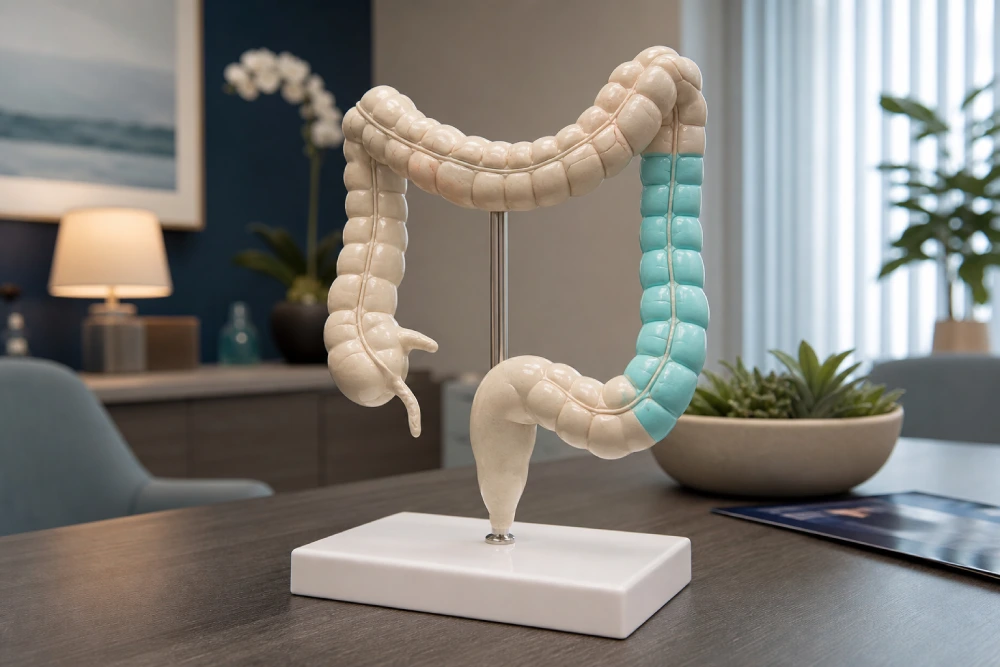
Colitis means inflammation of the colon, and ulcerative colitis is a long-term form that affects the colon and rectum. Colitis treatment with Dr Ganesh Sivaji, a Harrogate-based Consultant Gastroenterologist, starts with a colonoscopy and biopsies to confirm the type and extent, then uses medicines to settle flares, keep the bowel in remission and plan bowel cancer checks.
What Is Ulcerative Colitis?
Ulcerative colitis (UC) is a lifelong condition in which the immune system is thought to attack the lining of the large bowel, causing inflammation and ulcers. It usually begins in the rectum and lower colon and may spread to involve the whole large bowel. Most people are diagnosed between the ages of 20 and 40, and at least 1 in every 233 people in the UK live with it.
UC is a type of inflammatory bowel disease; read what inflammatory bowel disease is. The other main type, Crohn’s disease, can involve the gut anywhere from mouth to bottom. Dr Sivaji looks after both, as well as proctitis.
Signs of a Severe Colitis Flare: Get Urgent Help
| If you have colitis and… | Do this |
|---|---|
| Severe tummy pain | Phone 999 or go straight to A&E |
| Bleeding from your bottom that does not stop | Phone 999 or go straight to A&E |
| A lot of blood, or large clots, passed with your poo | Phone 999 or go straight to A&E |
| Vomit with blood or poo in it, or that resembles coffee grounds | Phone 999 or go straight to A&E |
| Very bad or bloody diarrhoea | Urgent GP slot or NHS 111; let your care team know too |
| A high temperature, shivers or a fast heartbeat | Urgent GP slot or NHS 111 |
| Being unable to pass wind or poo | Urgent GP slot or NHS 111 |
This follows the NHS advice on ulcerative colitis. A severe flare can need emergency treatment in hospital, so do not wait for it to settle, and get a lift or an ambulance rather than driving yourself.
Types of Colitis Dr Sivaji Treats
The type of colitis decides the treatment. Dr Sivaji assesses:
- Ulcerative colitis: from left-sided colitis to extensive colitis (pancolitis) involving most or all of the colon.
- Proctitis: UC limited to the rectum, often with bleeding, mucus, urgency or constipation; first treatment is usually a medicine given into the rectum.
- Microscopic colitis: ongoing watery diarrhoea where the colon looks normal on camera and the inflammation only shows on biopsies. It is most often diagnosed around the age of 60 and is more common in women.
- Colitis caused by infection: not a form of IBD; stool tests help rule it out when symptoms first start.
- Other causes: reduced blood supply (ischaemic colitis), radiotherapy and immunotherapy can also inflame the colon.
If your bowel turns out not to be inflamed, irritable bowel syndrome may be the cause instead.
Colonoscopy and Other Tests for Colitis
A gastroenterologist usually makes the diagnosis, and Dr Sivaji carries out the camera tests himself:
- Colonoscopy: a flexible camera examines the whole colon and shows how far inflammation reaches; read about private colonoscopy.
- Flexible sigmoidoscopy: a shorter test of the rectum and lower colon.
- Biopsies: tiny samples of the lining confirm the type of colitis.
- Blood tests: check for inflammation, anaemia and low vitamin or mineral levels.
- Stool tests: rule out infection, while faecal calprotectin measures inflammation and helps show whether new symptoms are a flare or IBS.
- Scans: an X-ray, CT or ultrasound are sometimes added.
As many as 1 in 10 people with UC are re-diagnosed with Crohn’s or unclassified IBD within five years, so the label is reviewed if the pattern changes.
Colitis Treatment Options
Treatment aims to relieve a flare and lower the chance of symptoms coming back. The choice depends on how much of your bowel is affected and how severe the symptoms are.
Aminosalicylates (5-ASAs)
The usual first treatment for mild to moderate UC. For proctitis and left-sided disease, NICE recommends starting with a 5-ASA given into the rectum as a suppository or enema, and adding tablets if remission has not come within 4 weeks.
Steroids
A time-limited course, by mouth or into the rectum, brings a flare under control. Steroids are kept to short courses.
Immunosuppressants and Biological Medicines
If flares needing steroids happen twice or more within 12 months, or aminosalicylates do not keep UC quiet, NICE suggests an immunosuppressant. Biological and targeted medicines, which block proteins that drive inflammation, are further options.
Colectomy Surgery
Removing part or all of the large bowel (colectomy) stops UC from coming back, but means living with an ileostomy or an internal pouch made from the small bowel. NICE expects you to hear about all options, including no treatment, and a colorectal surgeon explains life after surgery; Dr Sivaji refers rather than operates.
Self-Care Between Reviews
Keep taking prescribed medicines when well, avoid NSAID painkillers unless prescribed, keep alcohol within 14 units a week and manage stress. Antispasmodics can ease cramps.
Why Patients Choose Dr Sivaji for Colitis Treatment
- Treatment matched to extent and severity: proctitis, left-sided and extensive colitis are treated differently, and he explains why.
- Response checked, not assumed: follow-up endoscopy shows whether the inflammation is settling.
- Steady follow-up: reviews typically every 8 to 12 weeks.
- Training and NHS role: trained in gastroenterology in Yorkshire; an NHS consultant in Harrogate since 2010.
- Credentials: MBBS, MRCP (UK), FRCP; British Society of Gastroenterology and European Society of Gastrointestinal Endoscopy member; GMC Specialist Register.
Find out more about Dr Sivaji.
What to Expect at a Colitis Consultation
- Your history: a 30-minute consultation about bleeding, urgency, night-time bowel movements, pain, weight and any joint, skin or eye problems.
- Previous results: bring earlier colonoscopy reports, blood tests and a list of your medicines.
- Tests: stool and blood tests first, then colonoscopy or sigmoidoscopy where needed.
- The plan: which part of your colon is affected, the treatment he suggests and when he will see you next.
He sets out what each option could offer, its risks and the alternatives, including what may happen without treatment; the decision is yours.
Long-Term Colitis Care and Bowel Cancer Checks
UC is lifelong, so you should be offered regular check-ups to see how treatment is working and to watch for complications.
Colitis raises the chance of bowel cancer, although the actual increase is low. The risk starts to climb around 8 to 10 years after symptoms begin and is highest when most or all of the colon is inflamed. You will be offered regular screening colonoscopies, and Dr Sivaji explains your own surveillance plan in line with NICE.
- Bone health: UC can lead to weakened bones (osteoporosis).
- Anaemia and nutrients: blood tests watch for anaemia, and calcium or vitamin B12 supplements may help.
- Vaccinations: have the ones you are offered, as some UC medicines make infections more likely.
- Mood: feeling low is common; NHS talking therapies accept self-referral.
Where Dr Sivaji Sees Patients With Colitis
Colitis consultations run at two Harrogate sites.
| Hospital | Address | Notes |
|---|---|---|
| The Duchy Hospital | Queen’s Road, Harrogate HG2 0HF | Run by Circle Health Group |
| Harrogate Harlow | Harrogate | Confirm the site when booking |
The practice confirms in advance where your colonoscopy will take place. He holds evening and morning clinics; in an emergency call 999, and for urgent advice out of hours, NHS 111.
Private or NHS Colitis Care?
Dr Sivaji works in the NHS at Harrogate and District NHS Foundation Trust as well as privately, so he knows both routes. NHS colitis care comes through hospital IBD teams with IBD nurse specialists. Private care means choosing your consultant, a time that fits around work, and the same doctor at each review and colonoscopy.
Colitis Treatment Fees and Insurance
Before you book, the practice confirms 2026 fees in writing, including any colonoscopy.
| What you pay for | How it is quoted |
|---|---|
| First consultation, 30 minutes | Given to you before the visit |
| Colonoscopy or sigmoidoscopy | A separate written quote |
| Follow-up reviews | Confirmed as each is booked |
- Insurance: you can claim through BUPA, AXA, Vitality, Aviva or most other major insurers. Some policies limit cover for long-term conditions, so check yours and obtain pre-authorisation.
- Paying yourself: welcome; the practice can also help with insurance paperwork where possible.
FAQs About Colitis and Ulcerative Colitis
What is the difference between colitis and ulcerative colitis?
Colitis simply means an inflamed colon and has several causes, including infection, reduced blood supply and some cancer treatments. UC is one specific, lifelong type of IBD that affects the rectum and colon and needs long-term care.
What causes UC?
The cause is not known. It is thought to be an autoimmune condition, where the immune system attacks the bowel lining. It is more likely if a relative has it, and in people who used to smoke.
What does a colitis flare feel like?
Common signs are more frequent, urgent diarrhoea, often with blood or mucus, cramping pain low on the left side and tiredness. Some people also get painful joints, sore red eyes, mouth ulcers or a temperature.
How is UC diagnosed?
By a gastroenterologist, usually with a colonoscopy and biopsies, supported by blood tests, a stool sample and sometimes scans. Dr Sivaji does the colonoscopy personally and talks you through what he saw as soon as it is over.
Which medicines treat UC?
Aminosalicylates are the usual first choice, as tablets or given into the rectum. Short steroid courses settle flares, and immunosuppressants or biological and targeted medicines help when these are not enough.
How long does colitis treatment take to work?
It varies. For a mild to moderate flare, NICE uses a 4-week point to judge whether first-line treatment is working and adds or changes medicines if remission has not come. Dr Sivaji adjusts your plan at follow-up.
Will I need surgery for UC?
Not necessarily. Surgery may be advised if UC badly affects your life, the bowel is severely damaged, symptoms keep returning, other treatments fail or a flare is very severe. A colorectal surgeon carries out the operation.
Does UC raise bowel cancer risk?
Yes, but the increase is low. It rises from around 8 to 10 years after symptoms start and is higher with more extensive colitis, which is why regular screening colonoscopies are offered.
Can I have IBS and UC at the same time?
Yes. Some people with colitis develop IBS-type pain and diarrhoea even when the colitis is inactive, and a calprotectin test helps tell the two apart. Read how IBS and ulcerative colitis differ.
Can diet help colitis?
Certain foods can trigger flare-ups for some people, so a food diary helps you spot patterns. Eat a balanced diet, drink plenty during diarrhoea and check with your care team before cutting foods out.
Book a Consultation with Dr Ganesh Sivaji About Colitis
If you have colitis symptoms, a new diagnosis or a treatment that is no longer working, you can arrange to see Dr Sivaji without a GP referral.
- Request a time: Book a Consultation; someone from the practice will contact you.
- Ask a question: the contact page form reaches the practice team.
- What to bring: identification with a photo, your insurer’s details, past reports and the medicines you take.
This is general information, not a substitute for your own doctor’s advice. For severe tummy pain or heavy bleeding call 999 or go to A&E; NHS 111 can advise at other times.
At a glance
Where it affects
The rectum and colon only; proctitis means the rectum alone
Main symptoms
Diarrhoea with blood or mucus, urgency, lower-left tummy pain, tiredness
How it is diagnosed
Colonoscopy or sigmoidoscopy with biopsies, plus blood and stool tests
Aim of treatment
Settle the flare, then keep inflammation quiet (remission)
Severe flare signs
Very bad or bloody diarrhoea, a high temperature, a fast heartbeat
Long-term checks
Regular reviews and bowel cancer screening colonoscopies
Book this treatment
Same-week appointments available. Our coordinator confirms within 2 hours.