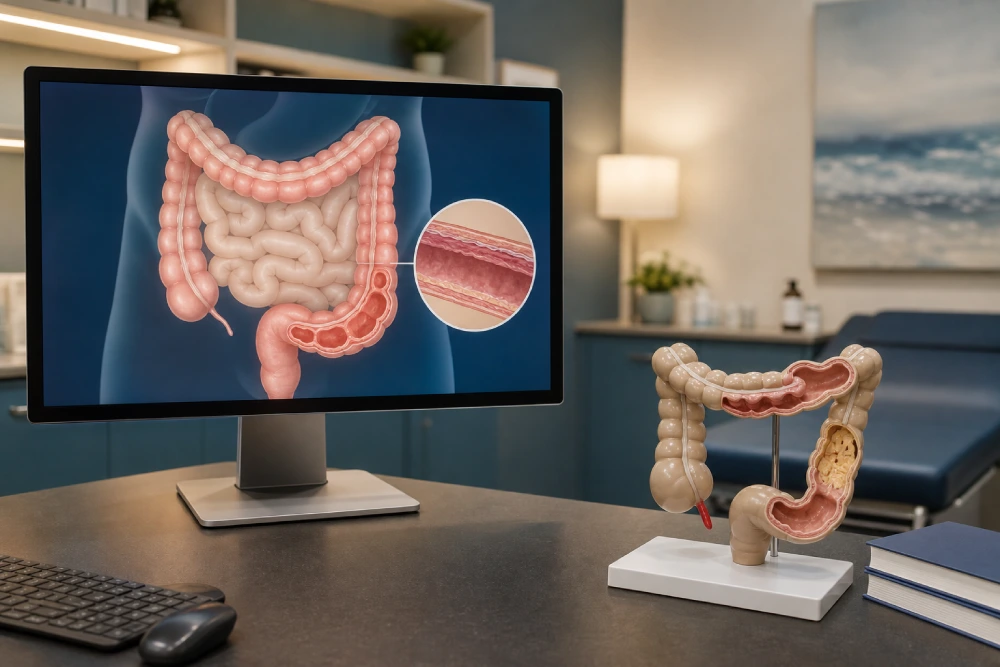
Crohn’s diagnosis and treatment means confirming Crohn’s disease with tests and keeping it under control with medicines and regular review. Crohn’s disease is a lifelong inflammatory bowel disease in which patches of the gut become inflamed. Care with Dr Ganesh Sivaji, Consultant Gastroenterologist in Harrogate, means confirming it with camera tests, scans, blood and stool tests, settling flares with medicines and reviewing you regularly to keep it under control.
What Is Crohn's Disease?
It is a long-term condition in which the immune system attacks part of the gut, causing inflammation and ulcers. It can appear anywhere along the digestive tract but is most common in the small bowel and colon, and the inflamed areas are often patchy, with healthy gut in between.
Crohn’s belongs to a group of conditions called inflammatory bowel disease (IBD). The other main type, ulcerative colitis, affects only the rectum and large bowel. It often starts in teenagers and younger adults, though any age can be affected.
Crohn's Flare Symptoms That Need Urgent Help
| Crohn’s symptom | Where to go now |
|---|---|
| Severe pain in your tummy | Call 999 or go to A&E |
| Bleeding from the bottom that keeps going, or heavy bleeding with clots | Call 999 or go to A&E |
| Vomiting blood or poo, or vomit like coffee grounds | Call 999 or go to A&E |
| Black or dark red poo | Urgent GP appointment or NHS 111 |
| Diarrhoea with blood in it | Urgent GP appointment or NHS 111 |
| Known Crohn’s getting worse, or treatment not helping | See your GP or contact your IBD team |
These steps follow the NHS page on Crohn’s disease and its advice on inflammatory bowel disease. If A&E is needed, have someone drive you or call an ambulance, and bring your medicines along.
Crohn's Symptoms and Complications Dr Sivaji Treats
Symptoms depend on which part of the gut is inflamed. Dr Sivaji assesses and treats:
- Diarrhoea: sometimes with blood or mucus.
- Tummy pain and pain around the bottom: including small tears near the anus (anal fissures).
- Tiredness, poor appetite and weight loss: absorbing nutrients can become harder.
- Fistulas: tunnels linking the bowel to another organ or the skin; around 1 in 3 people with Crohn’s develop one.
- Strictures: narrowed sections of bowel that can slow food or cause a blockage.
- Effects beyond the gut: joint pain, sore eyes and skin rashes; up to 1 in 2 people with Crohn’s have problems elsewhere in the body.
- Vitamin deficiencies and thinner bones: linked to inflammation, absorption problems and steroid use.
If tests show no inflammation, irritable bowel syndrome may explain the symptoms instead.
Tests for Crohn's Disease: Blood, Stool, Colonoscopy and Scans
No single test proves Crohn’s, and diagnosis can take time. Dr Sivaji builds the picture from several results:
- Blood tests: look for signs of inflammation and for complications.
- Stool test: a faecal calprotectin test shows whether the gut is inflamed.
- Colonoscopy or gastroscopy with biopsies: a thin camera tube shows the pattern and site of inflammation, and tiny tissue samples confirm it. Read about private colonoscopy.
- Scans: MRI, CT or ultrasound show how far the inflammation extends along the bowel.
- Small bowel capsule study: he also performs capsule studies, where you swallow a tiny camera, if one would help.
He then explains where the inflammation is and what it means for treatment.
Crohn's Disease Treatment Options
There is no permanent fix for Crohn’s yet, so treatment aims to bring on remission and keep you there. The choice depends on where the disease is and how active it is, and NICE expects side effects to be discussed openly.
Steroids for a Flare
NICE recommends a conventional steroid for a first flare, or a single flare within 12 months. A gut-targeted steroid with fewer side effects, though less effective, may suit some people.
Aminosalicylates
These anti-inflammatory medicines (5-ASAs) are less effective than steroids in Crohn’s but may have fewer side effects, so NICE suggests them when steroids are unsuitable or declined.
Immunosuppressants
With 2 or more flares in 12 months, or a steroid dose that cannot be reduced, a medicine that damps down the immune system may be added. A blood test for an enzyme called TPMT comes first for thiopurine medicines.
Biological Medicines
For severe active Crohn’s that has not responded to standard treatment, or where standard medicines cannot be used, NICE recommends biological therapy, with a reassessment after 12 months.
Liquid Diet (Enteral Nutrition)
A complete liquid diet can replace steroids for some people, mainly children and those who cannot take steroids.
Surgery Through a Colorectal Team
If medicines are not working, or one short section is affected, removing the damaged bowel can work well, though symptoms may return elsewhere. Dr Sivaji involves a colorectal surgeon.
Smoking, Painkillers and Choosing to Wait
Smoking raises the risk of flare-ups, and NSAID painkillers such as ibuprofen should be avoided unless a doctor recommends them. With mild symptoms, you may choose to monitor rather than start a new medicine.
Why Patients Choose Dr Sivaji for Crohn's Care
- Camera tests and clinic with one doctor: he performs colonoscopy and gastroscopy himself to check how treatment is working.
- You see where the inflammation is: results and medicine choices are explained clearly.
- Regular reviews: typically every 6 to 12 weeks, so treatment can be adjusted promptly.
- NHS consultant since 2010: at Harrogate and District NHS Foundation Trust, after specialist gastroenterology training in Yorkshire.
- Gut and liver care together: he also manages anaemia and liver conditions.
Qualifications: MBBS, MRCP (UK) and a Royal College of Physicians fellowship (FRCP), and he is a Full Member of the BSG (British Society of Gastroenterology). You can read Dr Sivaji’s background.
What to Expect at Your First Crohn's Appointment
- Before you come: gather earlier scan, blood test and endoscopy reports, plus a list of your medicines.
- A 30-minute consultation: your bowel habit, pain, weight, smoking, family history and any joint, eye or skin symptoms.
- Tests: the ones you need are arranged, often blood and stool tests before any camera test.
- A plan you understand: what each option involves and how you will be monitored.
He explains the benefits, side effects and alternatives of each treatment, including waiting, so you can decide together.
Living With Crohn's: Monitoring and Medicine Side Effects
Crohn’s affects everyone differently, and most people move between remission and flare-ups. Regular reviews help pick up changes early.
- Blood monitoring: NICE advises regular checks for people taking immunosuppressants.
- Bowel cancer checks: if your risk is high, you may be offered regular colonoscopies.
- Vaccinations: flu and pneumococcal vaccines are advised if your medicines affect the immune system, though some live vaccines may not be suitable.
- Diet: eat a balanced diet and avoid big changes without advice.
- Pregnancy and fertility: talk to your specialist before trying for a baby, as some medicines need changing.
Where Dr Sivaji Sees Patients With Crohn's Disease
Crohn’s reviews are held in Harrogate.
| Location | Where it is |
|---|---|
| The Duchy Hospital | Queen’s Road, Harrogate HG2 0HF |
| Harrogate Harlow | Harrogate, North Yorkshire |
Camera tests take place in a hospital endoscopy unit in Harrogate, confirmed when booked. Clinics run on some evenings and mornings; if you need urgent help when clinics are closed, contact NHS 111, or dial 999 in an emergency.
Private or NHS Care for Crohn's Disease?
Both can work well. Dr Sivaji is an NHS consultant and also sees patients privately. Private care lets you choose your consultant and a time that suits you, with the same doctor at each review. NHS care comes from hospital IBD teams, usually led by a consultant gastroenterologist with IBD nurse specialists.
Crohn's Care: Fees and Insurance
Fees for 2026 are set out in writing before any booking is made, whether you pay yourself or claim on insurance.
| Item | Fee |
|---|---|
| Initial consultation (30 minutes) | Confirmed in writing before booking |
| Follow-up reviews | Confirmed as each review is arranged |
| Colonoscopy, gastroscopy or scans | Quoted separately after your consultation |
- With insurance: most major insurers are accepted, including BUPA, AXA, Vitality and Aviva. Ask your insurer how it covers long-term conditions and get pre-authorisation before tests.
- Self-funding: you will know the full consultation fee in advance.
FAQs About Crohn's Disease
How is inflammatory bowel disease diagnosed?
With several tests rather than one. Blood and stool tests look for inflammation, a camera test with biopsies shows the gut lining, and scans check how much bowel is involved. A gastroenterologist then puts the results together; see what inflammatory bowel disease is.
Which tests confirm Crohn's?
Biopsies taken during a camera test, read alongside scan, blood and stool results, usually confirm it. Because no single test is decisive, it can take time, and Dr Sivaji may add tests if the picture is unclear.
Is Crohn's the same as ulcerative colitis?
No. Both are types of inflammatory bowel disease, but ulcerative colitis affects only the rectum and colon, while Crohn’s can appear anywhere in the gut, usually in patches. Sometimes doctors cannot tell them apart at first.
Will Crohn's go away?
Crohn’s is lifelong and there is no permanent fix yet. Most people have periods of remission, when symptoms are under control, alongside flare-ups. Treatment aims to make the calm spells as long as possible.
What is a Crohn's flare?
A flare-up is a spell when symptoms such as diarrhoea, pain and tiredness become active again. It may last a few days or several months. Smoking makes flare-ups more likely, but often no trigger is found.
Which medicines treat Crohn's?
Steroids, aminosalicylates, immunosuppressants and biological medicines are the main groups, alone or combined. Painkillers, laxatives and anti-diarrhoea medicines ease symptoms, and the plan depends on where the inflammation is.
Will I need surgery for Crohn's?
Not necessarily. Surgery is considered when only a short section is affected, when medicines are not working, or to treat complications such as strictures and fistulas. Dr Sivaji refers you to a colorectal surgeon if an operation may help.
Does smoking affect Crohn's?
Yes. Smoking is linked to developing Crohn’s and to more frequent flare-ups. NICE asks doctors to discuss not smoking, and your GP or a local stop smoking service can help you quit.
Can diet help Crohn's?
No particular diet has been proven to control it, but eating well matters because nutrients may be poorly absorbed. A food and symptom diary helps, and your care team can advise before you cut foods out.
How often will I need check-ups?
While treatment is being started or changed, Dr Sivaji typically reviews you every 6 to 12 weeks. After that, reviews are spaced as agreed with you, with blood tests for some medicines and colonoscopies if your bowel cancer risk is raised.
Book a Consultation with Dr Sivaji About Crohn's Disease
Newly diagnosed, waiting for answers or wanting a fresh look at treatment? You can book directly; no GP letter is required.
- Book online: Book a Consultation; the practice will contact you to fix a time.
- Send a question: use the practice contact form if you would like to check something first.
- Your GP: with your permission, Dr Sivaji can write to your GP after your visit.
Website information cannot replace a medical assessment. Call 999 or go to A&E for severe pain or heavy bleeding, and use NHS 111 for urgent advice at other times.
At a glance
What is it?
Long-term inflammation in patches of the gut, most often the small bowel and colon
Common symptoms
Diarrhoea, tummy pain, tiredness, weight loss, blood or mucus in poo
Tests used
Blood and stool tests, colonoscopy or gastroscopy with biopsies, and MRI, CT or ultrasound
Aim of treatment
Remission: long spells with few or no symptoms
Signs of a severe flare
Severe tummy pain, heavy bleeding or vomiting blood: call 999
Follow-up
Regular reviews, typically every 6 to 12 weeks
Book this treatment
Same-week appointments available. Our coordinator confirms within 2 hours.