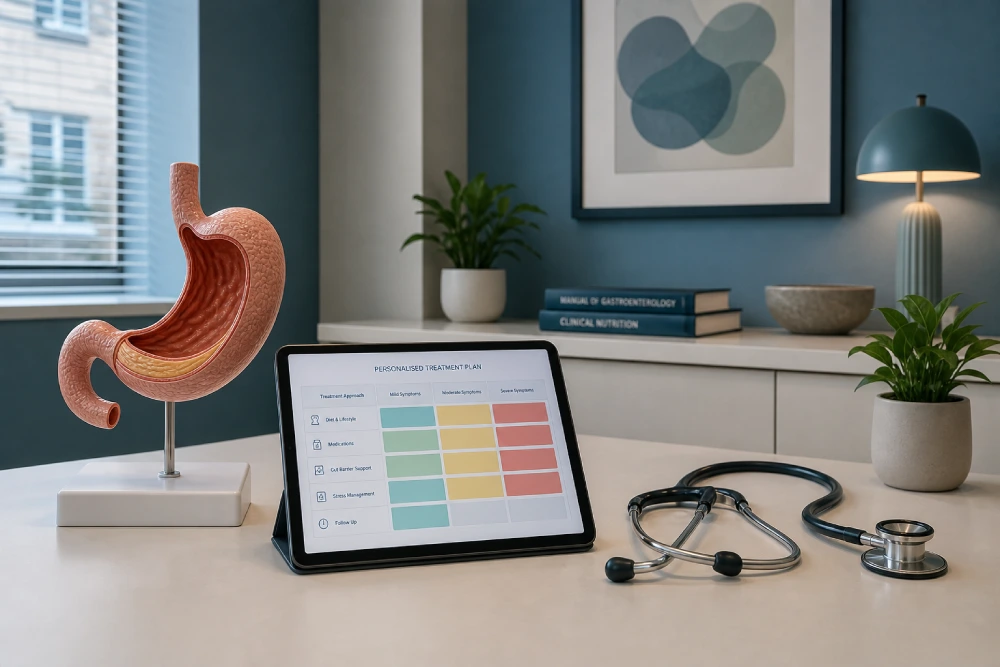
Functional dyspepsia is ongoing indigestion, such as early fullness or upper-tummy pain, when tests including a gastroscopy find no ulcer, inflammation or other cause. The symptoms are real and affect about 7 in 100 people. Functional dyspepsia treatment with Dr Ganesh Sivaji, consultant gastroenterologist at The Duchy Hospital, Harrogate, combines H. pylori treatment where needed, medicines, eating changes and gut–brain approaches.
What Is Functional Dyspepsia?
The British Society of Gastroenterology describes it as a common disorder of gut–brain interaction, affecting approximately 7% of people, with most looked after by their GP. In plain terms, the stomach looks healthy but the way it works, and the way the gut and brain communicate, is out of step. That is why the discomfort is genuine even though nothing shows on a scan.
NICE uses the term once a gastroscopy has ruled out other causes. Dr Sivaji’s interest is in how your stomach behaves, for example how quickly you fill up and when bloating starts, rather than only what the camera shows.
Why Tests Can Be Normal When Symptoms Are Real
A gastroscopy shows the lining of the gullet, stomach and duodenum: ulcers, inflammation and growths. It cannot show how the stomach is working, or how the gut and brain are communicating, so a clear report and daily discomfort can sit side by side.
This is common. NHS gastroenterology guidance from NHS Borders notes that some people with indigestion respond to H. pylori treatment and some to acid suppression, but the majority have functional dyspepsia. It also notes that cancer is exceptionally rare in people under 55 with indigestion and no alarm symptoms. Unless something new appears, repeating a normal gastroscopy rarely changes the plan.
When Indigestion Needs Urgent Help, Even After Normal Tests
| If you notice | Why it matters | Where to go |
|---|---|---|
| Vomit with blood in it, or that looks like coffee grounds | Possible bleeding | 999 or A&E |
| Poo that turns black, sticky and foul-smelling | Possible bleeding higher up | 999 or A&E |
| Sudden, severe pain in the tummy or chest | Needs emergency assessment | 999 or A&E |
| New pain on swallowing, or food that feels stuck | Not explained by an earlier normal test | Urgent GP appointment or NHS 111 |
| Weight falling without trying, or a swelling you can feel in your tummy | Should be checked soon | Urgent GP appointment or NHS 111 |
| Tiredness all the time with ongoing tummy pain | Possible anaemia from bleeding | Urgent GP appointment or NHS 111 |
The NHS page on gastritis lists the same emergency signs. A past normal result does not cover a new symptom, so tell Dr Sivaji or your GP about any change.
Functional Dyspepsia Symptoms Dr Sivaji Treats
Symptoms usually start or worsen around meals:
- Early fullness: feeling full after only a few mouthfuls.
- Bloating: a tight, swollen feeling high in the tummy.
- Upper-tummy pain or burning: an ache or heat just below the breastbone.
- Nausea: feeling sick, with or without vomiting.
- Stress-linked flares: stress and anxiety can make indigestion worse.
- Bowel symptoms as well: the condition is closely related to irritable bowel syndrome, another gut–brain disorder that affects the bowel.
The diagnosis is made only after other causes have been looked for. How that is done, and the warning signs that need a test, are set out on the dyspepsia (indigestion) page.
Functional Dyspepsia Treatment Options
No single treatment suits everyone, so options are tried in steps and reviewed.
Clearing H. pylori
If the stomach bacterium H. pylori is present, NICE advises treating it first. A routine retest afterwards is not usually needed.
A Trial of Low-Dose Acid Reduction
With H. pylori excluded and symptoms ongoing, NICE suggests a low-dose proton pump inhibitor or an H2 receptor antagonist for 4 weeks, then the lowest dose that helps, taken as needed where possible. Frequent long-term antacids should be avoided.
Gut–Brain Neuromodulators
In specialist care, a low-dose tricyclic antidepressant can be used to calm gut–brain signalling rather than to treat mood. Another antidepressant may suit early fullness with weight loss. These are off-label uses, so Dr Sivaji explains the reasons and possible side effects first.
Psychological Therapies
NICE recognises that cognitive behavioural therapy and psychotherapy may reduce symptoms in the short term, and gut-directed hypnotherapy or stress management help some people. Dr Sivaji may refer you for these.
Review and Adjustment
NICE recommends periodic monitoring. Follow-up visits let Dr Sivaji change doses, stop what is not working and step treatment down when things settle.
Managing Without Medicine
Some people, reassured by normal results, prefer to rely on eating and lifestyle changes alone. That is a fair choice to discuss.
Why Patients Choose Dr Sivaji for Functional Dyspepsia
- Normal results taken seriously: he treats your symptoms as real and treatable, even when every scan is clear.
- Attention to how the stomach works: questions about fullness, bloating and triggers shape the plan.
- Understanding comes first: he explains in everyday language why you feel unwell even though the tests are clear.
- The same consultant throughout: he can carry out and interpret your gastroscopy, then follow your progress.
- Treatment adjusted, not fixed: medicines are discussed, tried and changed according to your response.
Recognised expertise:
- Holds an NHS consultant role in Harrogate, at Harrogate and District NHS Foundation Trust, in post since 2010 after specialist training in Yorkshire
- Qualified MBBS in Chennai, then MRCP (UK) and a CCT in gastroenterology; elected FRCP in 2015
- Member of two specialist societies: the European Society of Gastrointestinal Endoscopy and the British Society of Gastroenterology
More on Dr Sivaji’s background.
Eating, Stress and Sleep: Day-to-Day Changes That Help
Alongside any medicine, these changes can help:
- Smaller, more frequent meals: rather than two or three large ones.
- Eating slowly: time to notice fullness before overeating.
- Spotting your triggers: fatty or spicy food, coffee and alcohol are common culprits, so note what sets yours off.
- An earlier evening meal: finishing eating well before you lie down.
- Moving more and not smoking: regular aerobic exercise and stopping smoking are part of NHS lifestyle advice.
- Stress and sleep: finding ways to relax and protecting your sleep can ease flares.
NHS Borders guidance finds no evidence for diet therapy such as low FODMAP in indigestion, so the focus is on how and when you eat rather than long lists of banned foods.
What to Expect When You See Dr Sivaji After Normal Tests
- Before you come: gather earlier gastroscopy reports, blood and H. pylori results, and a list of your medicines.
- Thirty minutes to talk: in a 30-minute consultation he asks about fullness, bloating, triggers, stress and sleep.
- Checking past tests: he reviews what has already been done; a test is repeated only if something has changed.
- H. pylori status: if you have never been tested, a breath or stool test is arranged, with acid-reducing tablets paused beforehand.
- Your decision: he sets out what each option could achieve, its possible side effects and the alternatives, including no medicine.
Where to See Dr Sivaji in Harrogate
You can be seen at either of two Harrogate locations.
| Clinic | Address | Notes |
|---|---|---|
| The Duchy Hospital | Queen’s Road, Harrogate HG2 0HF | A Circle Health Group hospital |
| Harrogate Harlow | Harrogate | Full details given when your visit is arranged |
Clinics run in the evenings and mornings; the team confirms your time. If symptoms flare at night or at a weekend, NHS 111 can help; in an emergency, dial 999.
Paying for Your Care: Fees and Insurance
Treatment often involves a first consultation and one or more reviews. All 2026 fees are set out in writing before you commit to booking.
| Item | Pricing |
|---|---|
| First consultation (30 minutes) | Confirmed before you attend |
| Follow-up reviews | Confirmed when each is arranged |
| Breath, stool or blood tests | Quoted only if needed |
| Gastroscopy | Separate hospital quote, if one is recommended |
- Paying privately: self-funding patients are welcome and see the whole fee in advance.
- Insured patients: policies from Vitality, BUPA, Aviva, AXA and most other large insurers are accepted; confirm your benefits and pre-authorisation, and the practice will deal with the claim where possible.
Frequently Asked Questions After Normal Tests
What does functional dyspepsia feel like?
Most people describe filling up quickly, feeling uncomfortably full or bloated after meals, nausea, or a burning ache high in the tummy. The symptoms are similar to other indigestion, which is why tests come first.
How is the diagnosis made?
It is made once a gastroscopy and other tests, such as an H. pylori check, have found no other cause. NICE calls this endoscopically determined. Your history matters as much as the tests.
Is functional dyspepsia serious?
Serious disease is rare when tests are normal and there are no warning signs, particularly under 55. It can still disrupt eating, work and sleep, so it deserves proper treatment rather than being dismissed.
Why is my gastroscopy normal if I still have pain?
The camera shows the stomach lining, not how the stomach is working or how gut and brain are communicating. In this condition the problem lies in that function, so the pictures look healthy.
Can H. pylori cause these symptoms?
Sometimes. NICE advises eradication therapy for anyone who tests positive, and some people improve once the infection has gone. If symptoms continue afterwards, the other treatments on this page are the next step.
Which medicines are used, and are they antidepressants?
Low-dose acid-reducing medicines usually come first. Some people are offered a low-dose tricyclic antidepressant, used as a gut–brain neuromodulator rather than for depression. Dr Sivaji explains the dose, timing and side effects before you decide.
Can changing my diet help?
Yes, mainly through smaller meals, eating slowly and avoiding personal triggers. Strict exclusion diets have no proven benefit here, so there is little reason to cut out whole food groups without advice.
Can stress or anxiety make it worse?
They can. The NHS lists stress and anxiety among things that worsen indigestion, and gut-directed therapies such as cognitive behavioural therapy or hypnotherapy help some people alongside other treatment.
Is functional dyspepsia the same as IBS?
No, but they are related. Both are disorders of gut–brain interaction; functional dyspepsia affects the upper tummy around meals, while irritable bowel syndrome affects the bowel, with changes such as diarrhoea or constipation.
Will functional dyspepsia go away?
There is no single quick fix, and NICE describes ongoing management with periodic review. When symptoms are under control, NICE encourages stepping medicines down or stopping them, and lifestyle changes stay useful throughout.
Book a Consultation with Dr Sivaji About Functional Dyspepsia
If normal tests have left you with symptoms and no clear plan, a consultation is a sensible next step.
- Request a time: complete the online appointment request; no GP referral is needed.
- Ask a question: use the practice contact form.
- If symptoms change suddenly: vomiting blood, black poo or severe pain need 999 or A&E; for other urgent advice, contact NHS 111.
At a glance
What is it?
Long-lasting indigestion with no visible cause, classed as a disorder of gut–brain interaction
Typical symptoms
Feeling full quickly, bloating, nausea, pain or burning in the upper tummy
How is it confirmed?
A normal gastroscopy and other tests that rule out ulcers, reflux damage and infection
Treatment NICE starts with
Clearing H. pylori if present, then a 4-week trial of low-dose acid-reducing medicine
Further options
Gut–brain medicines, psychological therapies, changes to eating, stress and sleep
When to get help fast
Vomiting blood, black poo, new swallowing problems, weight loss
Book this treatment
Same-week appointments available. Our coordinator confirms within 2 hours.