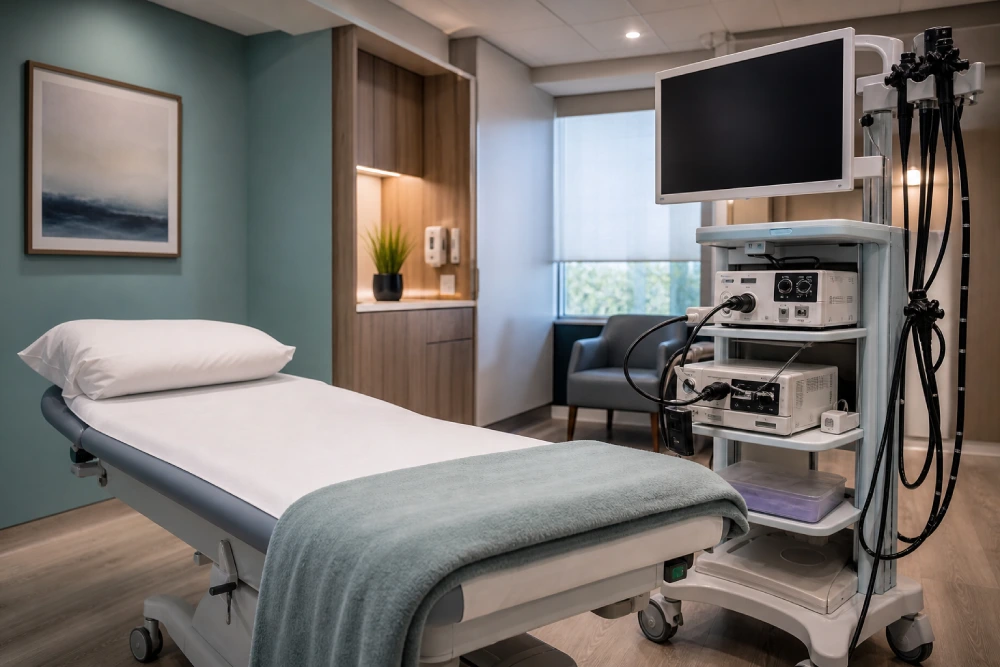
A private colonoscopy is a camera test that checks the whole of your large bowel (the colon and rectum). In Harrogate, consultant gastroenterologist Dr Ganesh Sivaji performs it himself for bleeding, a change in bowel habit, a positive FIT result or follow-up after polyps. Small polyps can usually be removed during the test, and you do not need a GP referral to book.
What Is a Colonoscopy?
A colonoscopy looks directly at the lining of your large bowel. A long, thin, flexible tube with a small camera at its tip (a colonoscope) is passed into your bottom and guided around the colon, and air is used to open the bowel so the pictures on the screen are clear.
It is a type of endoscopy for the lower bowel. Symptoms higher up, such as indigestion or trouble swallowing, are checked with a private endoscopy (gastroscopy) instead. Because Dr Sivaji can take small tissue samples (biopsies) and remove polyps through the colonoscope, finding a problem and dealing with part of it can happen in one visit.
Bowel Symptoms That Need Urgent Help
| Symptom | What to do |
|---|---|
| Bleeding non-stop from your bottom, or so much blood that the toilet water turns red or you pass large clots | 999 or A&E now |
| Black or dark red poo, or bloody diarrhoea | Ask for an urgent GP appointment or contact NHS 111 |
| After a colonoscopy: heavy or worsening bleeding, severe or worsening tummy pain, or a high temperature with shivers | Call NHS 111 or the hospital where you had the test |
| Slime (mucus) or blood in your poo for 3 weeks or more, or a lasting change in bowel habit | See a GP or book a consultation |
Do not drive yourself to A&E. The table follows the NHS advice on bowel cancer symptoms and the NHS aftercare guidance for colonoscopy.
Bowel Problems a Colonoscopy Can Investigate
Dr Sivaji may suggest a colonoscopy if you have:
- Bleeding from the bottom or blood in your poo: to find the source.
- Diarrhoea or constipation that does not settle.
- Weight loss, tiredness or iron-deficiency anaemia with no clear reason.
- A positive FIT result: blood found in a poo sample.
- Inflammation: to confirm or monitor Crohn’s disease and ulcerative colitis.
- Possible diverticular disease.
- Earlier colon polyps: a planned check-up colonoscopy.
- A close relative with bowel cancer: see colon cancer diagnosis for symptoms and screening.
Most of the time a colonoscopy finds nothing to worry about.
Options for Checking Your Bowel: Colonoscopy, FIT and CT Colonography
Dr Sivaji explains which test suits your symptoms and health, including the choice to wait.
FIT Poo Test
A home kit that detects tiny traces of blood in poo. NICE advises GPs to use it to guide urgent referral; a positive result shows bleeding, not its cause, so a colonoscopy usually follows.
Flexible Sigmoidoscopy
Checks only the rectum and lower bowel, often after an enema instead of full preparation. It takes 10 to 20 minutes, usually without sedation, and Dr Sivaji performs it when symptoms point low down.
CT Colonography
A CT scan of the bowel (virtual colonoscopy), taking around 20 minutes after bowel emptying. Nothing can be removed during a scan, so an abnormal result may lead to a colonoscopy.
Colonoscopy
Views the whole large bowel and allows biopsies and polyp removal in one sitting, but needs the fullest preparation and carries small risks.
Monitoring First
With mild, recent symptoms and no warning signs, you may agree to watch them and test only if they persist.
Why Patients Choose Dr Sivaji for Colonoscopy
- The consultant does the test: Dr Sivaji meets you beforehand, carries out the colonoscopy in person and talks you through what he saw.
- Endoscopy is central to his work: he specialises in diagnostic and therapeutic endoscopy and also trains other endoscopists.
- Consultant posts: appointed to Harrogate and District NHS Foundation Trust in 2010, having completed his gastroenterology specialist training in Yorkshire.
- Qualifications and memberships: MBBS, MRCP (UK) and FRCP; he belongs to the British Society of Gastroenterology as a full member and to the European Society of Gastrointestinal Endoscopy.
- Plain explanations: you hear what was seen before you leave, with a written report to take home.
There is more on Dr Sivaji’s background.
Bowel Preparation: The Two Days Before Your Test
The view is only as good as the preparation. Your endoscopy unit sends written instructions with the laxatives; follow those, as units differ slightly.
- When your letter arrives: tell the unit if you are pregnant, have diabetes, or take blood thinners or other regular medicines.
- About a week before: you may be asked to stop iron tablets or other medicines that cause constipation.
- 2 days before: plain foods only, such as plain chicken without sauce, white rice, pasta or bread, and clear soup.
- The day before: drink the laxative sachets at the set times and stay near a toilet, as diarrhoea starts within a few hours. Keep drinking clear fluids.
- On the morning: stop eating and drinking when your letter says, and bring your medicines.
If the laxative is not taken as directed, the test may not be possible on the day.
What Happens on the Day of Your Colonoscopy
- Arrival: a nurse explains the plan and gives you a gown.
- Consent: the risks are explained before you sign.
- Comfort: painkillers and conscious sedation go through a small tube in your arm; some units offer gas and air, and deeper sedation with an anaesthetist can be arranged.
- The test: you lie on your left side. Air can make you feel bloated, crampy or as if you need the toilet, but it should not hurt.
- Samples and polyps: taken through the scope; you will not feel this.
- Timing: the colonoscopy takes 30 to 45 minutes, and you may be at the hospital for around 2 hours in total.
With sedation you may remember little of it. Beforehand, Dr Sivaji explains the benefits, risks and alternatives, including a different test or none.
Recovery and Risks After a Colonoscopy
Nurses monitor you in recovery, and Dr Sivaji tells you what he found before you go home.
- Bloating and cramps: common for 2 to 3 hours as the air passes.
- A little blood: in your poo or from your bottom for a couple of days is common.
- After sedation: someone must collect you and stay with you overnight. For 24 hours, do not drive, drink alcohol, operate machinery or sign legal documents.
Serious problems are rare. The NHS lists three:
- A reaction to the sedation: such as brief breathing difficulty, treated with oxygen.
- Heavy bleeding afterwards.
- A small tear in the bowel wall (perforation): very rare, but likely to need surgery.
Laboratory results on biopsies or polyps take longer; Dr Sivaji tells you when to expect them.
Where Your Colonoscopy Takes Place in Harrogate
Consultations are held in Harrogate, and the hospital endoscopy unit for your test is confirmed when it is booked.
| Location | Address |
|---|---|
| Circle Health Group’s Duchy Hospital | Queen’s Road, Harrogate HG2 0HF |
| Harrogate Harlow | Harrogate |
He holds evening and morning clinics, with times confirmed when you book. Out of hours, contact NHS 111, or call 999 in an emergency.
Private or NHS Colonoscopy?
Dr Sivaji also works in the NHS as a consultant for Harrogate and District NHS Foundation Trust. On the NHS, people aged 50 to 74 are sent a home FIT kit every 2 years and offered a colonoscopy if blood is found, and anyone with symptoms is referred by their GP. A private colonoscopy adds a choice of consultant and date, and you see the same doctor before and after the test. Both routes are reasonable.
Private Colonoscopy Fees and Insurance
The fee depends on whether biopsies or polyp removal are needed and on the type of sedation. Your 2026 fee is confirmed in writing before the test is booked.
| Part of your care | How it is priced |
|---|---|
| Consultation with Dr Sivaji (around 30 minutes) | Quoted when you book |
| Colonoscopy, sedation and hospital charges | Quoted in advance of the test |
- Health insurance: policies with BUPA, AXA, Vitality and Aviva are accepted, along with most major insurers; check your cover and get a pre-authorisation code before the test.
- Paying for yourself: self-pay patients are welcome and know the full fee before the appointment.
FAQs About Private Colonoscopy
Do I need a GP referral for a private colonoscopy?
No. You can book directly, and the test is usually arranged after a short consultation with Dr Sivaji. He can write to your GP if you wish. Some insurers want a GP letter, so check your policy.
How do I prepare for a colonoscopy?
Plain foods for 2 days, then laxative sachets the day before. Follow the hospital’s written instructions exactly, and mention iron tablets, blood thinners or diabetes medicines as soon as your letter arrives.
Will I be sedated?
Conscious sedation is usual: it relaxes you while you stay awake enough to follow simple requests. You may remember little afterwards. Deeper sedation with an anaesthetist can be arranged on request.
How long does a colonoscopy take?
Usually 30 to 45 minutes. With checks beforehand and time in recovery, expect to be at the hospital for around 2 hours, sometimes longer after sedation.
Does a colonoscopy hurt?
It can be uncomfortable, with bloating and cramps as air opens the bowel, but it should not be painful. Tell Dr Sivaji if you need him to slow down or pause.
Can polyps be removed during the test?
Usually, yes. Small polyps are removed with a wire loop passed through the colonoscope and sent to the laboratory. Very large or numerous polyps may need a separate procedure.
Is a private colonoscopy the same as NHS bowel cancer screening?
The camera test is the same, but NHS screening starts with a home FIT kit every 2 years from 50 to 74. A private test is booked for symptoms, family history or polyp follow-up.
When can I drive and go back to work?
After sedation, wait 24 hours before driving, drinking alcohol or signing anything legally binding, and plan your return to work around that. On the preparation day, stay at home near a toilet.
What are the risks of a colonoscopy?
Serious problems are rare: a reaction to the sedation, heavy bleeding (mainly after biopsies or polyp removal) and a small tear in the bowel wall. Dr Sivaji explains your own risk before you consent.
When will I get my results?
You hear what Dr Sivaji saw before you leave, with a written report. Laboratory results on any samples follow later, and he arranges follow-up if anything needs action.
Book a Consultation with Dr Ganesh Sivaji for a Colonoscopy
A consultation is the place to decide whether a private colonoscopy is the right next step.
- Online: Book a Consultation to request a date for your consultation.
- A question before booking? Send it through the contact form.
If you are bleeding heavily from your bottom and it will not stop, call 999 or go to A&E. For urgent advice at night or at weekends, contact NHS 111.
At a glance
What does it check?
The colon and rectum, using a thin flexible camera
How long does it take?
30 to 45 minutes; allow around 2 hours at the hospital
Bowel preparation
Plain foods for 2 days, then laxative sachets the day before
Comfort options
Painkillers and conscious sedation; deeper sedation with an anaesthetist on request
What if a polyp is found?
It is usually removed there and then and sent to the laboratory
Do I need a referral?
No; you can book directly and your GP can be kept informed
Book this treatment
Same-week appointments available. Our coordinator confirms within 2 hours.