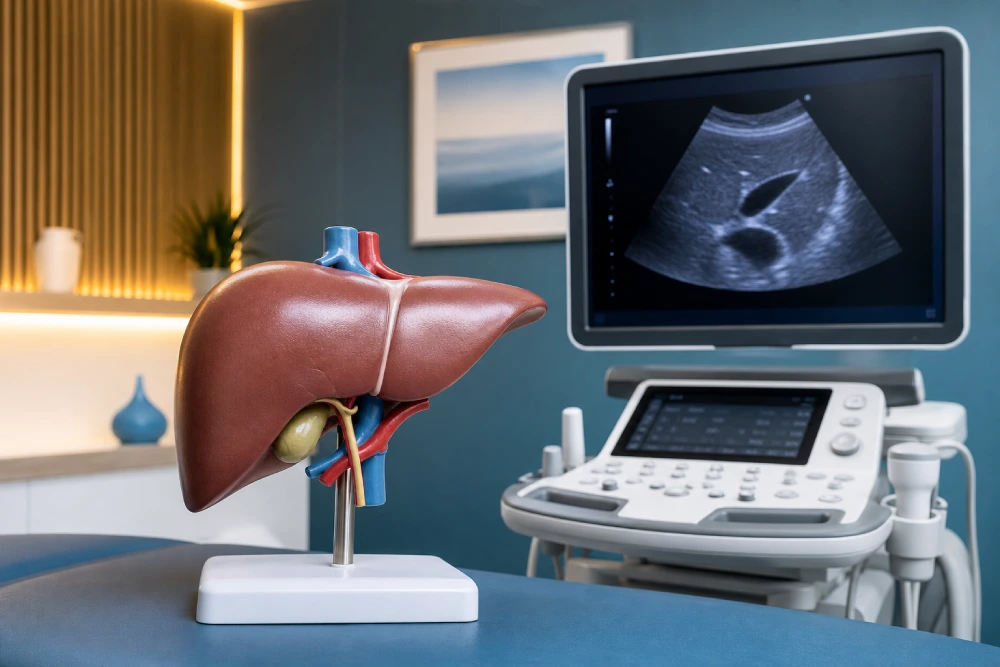
Liver disease management means finding the cause of a liver problem, checking for scarring and treating it over time. Most liver problems cause no symptoms until scarring is advanced. Dr Ganesh Sivaji, a Harrogate Consultant Gastroenterologist, looks for the cause (fatty liver, alcohol, hepatitis B or C, or an autoimmune condition), treats it and keeps watch on your liver.
What Is Liver Disease?
It is a broad name for conditions that harm the liver over months or years. The NHS groups the common types by cause: fat building up in the liver, regular heavy drinking, viruses such as hepatitis B and C, an inherited condition called haemochromatosis, and immune problems such as primary biliary cholangitis.
Damage builds quietly, and by the time symptoms appear the liver is often scarred (cirrhosis). Hepatology, or liver medicine, is one of Dr Sivaji’s specialist areas, and he looks after the whole range, from an unexplained blood result to established cirrhosis.
Liver Symptoms That Need Urgent Help
| What you notice | What it may mean | What to do |
|---|---|---|
| Vomiting blood, or vomit like coffee grounds | Bleeding in the gut | Ring 999 or go straight to A&E |
| Black or sticky poo | Bleeding in the gut | Ring 999 or go straight to A&E |
| Sudden confusion or slurred speech | Brain changes linked to liver damage | Ring 999 or go straight to A&E |
| Tummy pain or breathlessness when alcohol may be harming your liver | Worsening alcohol damage | Ring 999 or go straight to A&E |
| Yellow skin or eyes, with known cirrhosis | Jaundice | Ask your GP to see you urgently, or call NHS 111 |
| Swollen tummy, legs or ankles, with known cirrhosis | Fluid build-up (ascites) | Ask your GP to see you urgently, or call NHS 111 |
This follows the NHS page on cirrhosis. Don’t drive there yourself: get a lift or ring for an ambulance, and take your medicines with you. If you feel well but suspect a liver problem, see your GP or book a routine visit.
Liver Conditions Dr Sivaji Manages
He sees people with:
- Abnormal liver blood tests: a raised result from a GP check or another test, with no known cause yet.
- Fatty liver (NAFLD, now also called MASLD): fat stored in the liver, more common with excess weight, type 2 diabetes, high blood pressure or cholesterol, and after 50.
- Alcohol-related liver damage (ARLD): progresses from fatty liver to alcohol-related hepatitis, then cirrhosis; women develop it at lower drinking levels.
- Hepatitis B: spread through blood and body fluids; infection lasting over 6 months is called chronic.
- Hepatitis C: a blood-borne virus many people carry for years unaware.
- Cirrhosis: severe scarring from any cause, needing regular checks.
- Autoimmune liver conditions: such as autoimmune hepatitis or primary biliary cholangitis.
Liver cancer treatment and transplant assessment happen in specialist liver centres; if you need either, Dr Sivaji arranges the referral.
Blood Tests, Scans and Liver Stiffness Checks
Measuring scarring matters as much as finding the cause. Dr Sivaji follows NICE guidance:
- Liver blood tests and a virus screen: including hepatitis B and C. NICE warns that normal routine results do not rule out fatty liver or cirrhosis.
- Ultrasound scan: confirms fat in the liver and helps rule out other causes.
- Enhanced liver fibrosis (ELF) test: a blood test for people with MASLD. A score of 10.51 or above means advanced scarring; below it, adults are retested every 3 years.
- Liver stiffness scan (transient elastography): measures how stiff the liver is. NICE offers it to check for cirrhosis with hepatitis C, ARLD, or months of drinking over 50 units a week (men) or 35 (women).
- Liver biopsy: a small sample of liver for the laboratory, used when other tests cannot answer the question.
- Gastroscopy: after a cirrhosis diagnosis, NICE advises a camera test for swollen veins in the gullet (oesophageal varices) unless you start a beta blocker. Dr Sivaji performs it; see private endoscopy in Harrogate.
Liver Disease Treatment Options
Treatment depends on the cause and the damage; more than one route may apply:
Healthy Weight and Activity for Fatty Liver
Losing excess weight, a balanced diet and at least 150 minutes of exercise a week reduce liver fat. Most people need nothing more unless damage has developed.
Stopping Alcohol
For ARLD the aim is to stop completely, at any stage. Your GP or an alcohol service can offer talking therapies and medicines for cravings. Heavy drinkers should get medical help first, as stopping suddenly can be dangerous.
Antiviral Medicines for Hepatitis B and C
Daily antiviral tablets for 8 to 12 weeks clear hepatitis C in most people. Chronic hepatitis B cannot be removed for good, but antivirals can control it.
Cirrhosis Care and Liver Cancer Checks
Treating the cause can slow cirrhosis. Beta blockers, water tablets, laxatives and antibiotics help prevent complications, and NICE advises an ultrasound every 6 months to look for early liver cancer.
Referral to a Specialist Liver Centre
If cirrhosis becomes severe, Dr Sivaji refers you to a specialist centre, where a transplant can be considered.
Monitoring Without Medicines
With simple fatty liver and a low ELF score, lifestyle change and checks with your GP may be enough. Choosing no treatment for now is also valid; he will explain what that means.
Why Patients Choose Dr Sivaji for Liver Disease Management
- Liver medicine is part of his everyday work: it sits alongside bowel and stomach medicine and endoscopy in his practice.
- The same consultant from first test to follow-up: he reviews your results himself and adjusts treatment at later visits.
- Gastroscopy without a second referral: he performs upper GI endoscopy himself.
- NHS consultant in Harrogate since 2010: he holds a consultant post with Harrogate and District NHS Foundation Trust and trained as a specialist in Yorkshire.
- Explanations you can follow: a patient once told him the scariest part was not understanding the diagnosis, so he uses plain language and you leave with a clear plan.
Qualifications and memberships:
- MBBS, MRCP (UK), FRCP; Fellow of the Royal College of Physicians
- British Society of Gastroenterology (full member) and European Society of Gastrointestinal Endoscopy (member)
Read more about Dr Sivaji, or see the full list of treatments he offers.
What Happens at Your First Liver Appointment
- Arranging it: no GP letter is required, and you can book for a relative.
- What to bring: photo ID, insurance details, recent results or letters, and a list of medicines, including herbal ones.
- Your history: over 30 minutes he asks about hepatitis exposure, alcohol, family history and medicines, then examines you.
- Tests: he arranges only the blood tests and scans you need.
- Your plan: the likely cause, how serious it is and what could happen without treatment.
He sets out the benefits, risks and alternatives, including lifestyle change alone or GP follow-up, and can write to your GP.
Alcohol, Weight and Everyday Liver Health
The NHS says simple lifestyle changes lower the risk of many types of liver damage:
- Alcohol: no more than 14 units a week, spread across 3 days or more; half a pint of beer is about 1 unit. With cirrhosis, avoid alcohol completely.
- Weight and exercise: both lower liver fat and the linked risks of type 2 diabetes and high blood pressure.
- Medicines: with cirrhosis, ask a pharmacist before taking any, including herbal remedies.
- Vaccines: hepatitis A and B jabs if at risk; flu and pneumococcal jabs with cirrhosis.
- Hepatitis C testing: ask if you have shared drug equipment or had a UK transfusion before 1996; adults can order a free NHS home test.
Where Dr Sivaji Sees Liver Patients in Harrogate
He sees liver patients at two Harrogate hospitals:
| Hospital | Address |
|---|---|
| The Duchy Hospital (a Circle Health Group hospital) | Queen’s Road, Harrogate, North Yorkshire HG2 0HF |
| Harrogate Harlow | Harrogate |
He holds evening and morning clinics, and the hospital and time are confirmed when you book. Outside clinic hours, use NHS 111, or 999 in an emergency.
Private or NHS Liver Care?
Dr Sivaji works in both systems, as an NHS consultant in Harrogate and in private practice. On the NHS, your GP usually starts the tests and refers you to a liver specialist in hospital if damage is found. Privately, you can refer yourself, choose a time and see the same consultant at each visit.
Liver Consultation Fees and Insurance
| How you pay | What to know |
|---|---|
| Self-pay | Full fee given before the appointment |
| Private medical insurance | Accepted by BUPA, AXA, Vitality and Aviva, plus most other large insurers |
| Claims | Handled by the team where possible |
- Using insurance: check your outpatient cover and get pre-authorisation first; self-funding patients are equally welcome.
Every 2026 fee is set out in writing before your booking is confirmed.
Frequently Asked Questions About Your Liver
What are the early signs of liver disease?
Often there are none. Some people feel very tired, lose their appetite or ache under the right ribs. Yellow skin, itching and a swollen tummy tend to appear only once scarring is advanced.
What do abnormal liver blood tests mean?
They show something may be affecting the liver, not what or how serious. Causes range from fatty liver and alcohol to hepatitis. Dr Sivaji reviews your history and adds the right tests, such as an ultrasound.
Is fatty liver serious?
Usually not at first. Most people only have simple fat build-up, which causes no problems. A small number progress to inflammation, scarring and cirrhosis, and lifestyle changes help prevent that.
Can liver damage be reversed?
Early damage often can. Fatty liver can improve with weight loss, and early alcohol damage usually recovers if you stop drinking. Cirrhosis cannot usually be reversed, but treatment can slow it.
What is cirrhosis?
It is severe scarring after long-term damage. Many people feel well for years, but it can lead to bleeding, fluid build-up, confusion, liver failure or liver cancer, so regular checks matter.
How are hepatitis B and C treated?
Hepatitis C needs a course of daily antiviral tablets, which clears the virus for most people. Chronic hepatitis B is kept under control with antivirals and regular liver checks rather than removed.
Will I need a liver biopsy?
Most people do not. Blood tests, ultrasound and a stiffness scan usually give the answer. NICE suggests a biopsy when a stiffness scan is unsuitable, and Dr Sivaji explains why before arranging one.
What is a liver stiffness scan?
Also called transient elastography, it measures how stiff the liver is, and a higher score suggests more scarring (fibrosis). NICE recommends it to check for cirrhosis in higher-risk groups, such as people with hepatitis C.
How much alcohol is safe for my liver?
If you drink, the NHS limit is 14 units a week over at least 3 days, and regularly going just over it can harm you. With existing liver damage, Dr Sivaji may advise stopping altogether.
When should I see a liver specialist?
When blood tests stay abnormal, a scan shows fat or scarring, or you have hepatitis B or C. NICE advises specialist review for advanced scarring or cirrhosis. You can book directly, without a letter from your GP.
Book a Liver Consultation with Dr Ganesh Sivaji
Request a liver assessment through the online booking form, or ask a question via the contact form; the team will be in touch to agree a time.
Vomiting blood, black poo or sudden confusion cannot wait for a clinic: call 999 or go to A&E.
At a glance
Common causes
Fatty liver, alcohol, hepatitis B or C, autoimmune conditions
Early signs
Often none; sometimes tiredness or ache under the right ribs
Main tests
Blood tests, ultrasound, a scarring test or liver stiffness scan, rarely a biopsy
First consultation
30 minutes with Dr Sivaji
Signs that cannot wait
Vomiting blood, black poo or sudden confusion: call 999
Follow-up
Regular reviews; 6-monthly ultrasound with cirrhosis
Book this treatment
Same-week appointments available. Our coordinator confirms within 2 hours.